Fish loses value by the hour without proper cold. Whether you run a landing site, a fish market store or a processing plant, the right setup is a freezer room at −18 to −25 °C for storage — plus blast freezing capacity if fresh catch arrives warm and must be frozen fast.
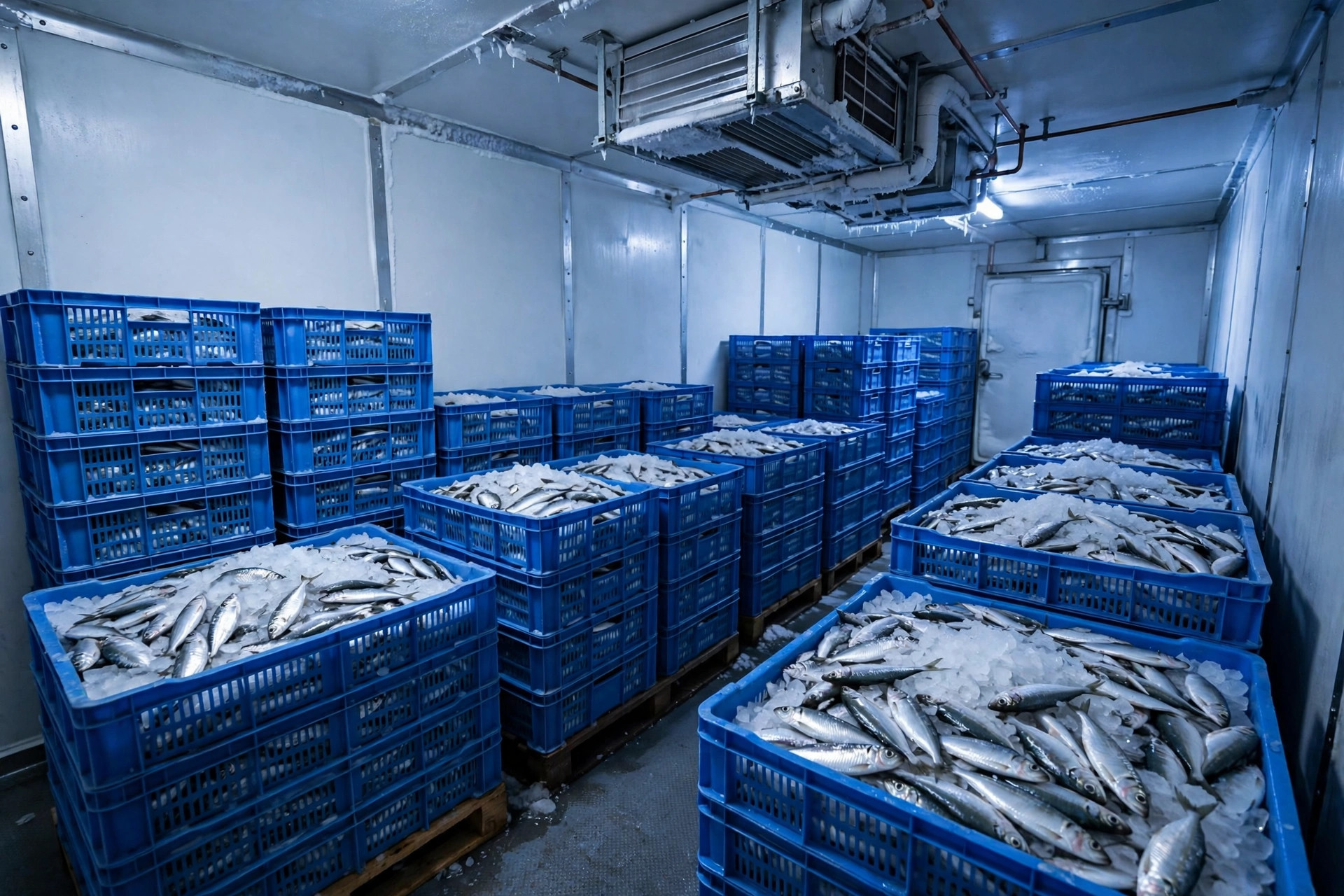
Keeps already-frozen fish at temperature for weeks to months. This is the standard cold room: 120 mm PU panels, a condensing unit sized for holding duty, and good door discipline. Most fish traders and distributors need this room.
Pulls fresh fish down through the freezing zone quickly, which protects texture and weight. Needs 150 mm panels and much higher refrigeration capacity per batch. If you buy fresh catch at the beach or market and freeze it yourself, this is the room that does the freezing — the storage room then holds it.
Fish sites are wet and corrosive. Ask for anti-corrosion evaporator coating and stainless or coated fittings in the wet zone — small money at order time, big money saved later.
Insulated floor panels with a hard-wearing finish, and a layout that lets melt-water and wash-down drain away, keep the room hygienic and the ice where it belongs.
At landing sites with unstable grid, a hybrid solar configuration or generator-ready controls protect a full room of fish from one bad night. See the solar cold room page.
| Item | Typical recommendation |
|---|---|
| Temperature | −18 to −25 °C storage; below −30 °C for blast freezing |
| Panel | 120 mm PU (storage) / 150 mm PU (blast) |
| Door | Hinged for small rooms; sliding once trolleys or forklifts are used |
| Extras worth adding | Strip curtain or air curtain, temperature alarm, anti-corrosion evaporator, spare parts kit |
For frozen storage, −18 °C is the widely used minimum and −20 to −25 °C gives better shelf life and margin against door openings. Freezing fresh fish quickly needs blast temperatures below −30 °C.
You need freezing capacity for that daily tonne (blast freezer or a freezer room with units sized for the pull-down load), plus storage volume for your selling cycle. Send us the daily quantity and how many days of stock you hold — we size both parts and quote the combination.
Yes, for modest daily volumes a freezer room can be specified with extra capacity to freeze a daily batch and then hold it. For large daily intakes, separate blast and storage rooms are more economical to run. We will tell you honestly which side of that line your volumes fall on.
Room size (or storage tonnage), fresh intake per day in kg, target temperature, and your country/port. Use the calculator or just message us on WhatsApp.
Tell us your storage tonnage and daily fresh intake — we reply with a configuration and an exact quotation, normally within 24 hours on working days.
 ColdRoomKit