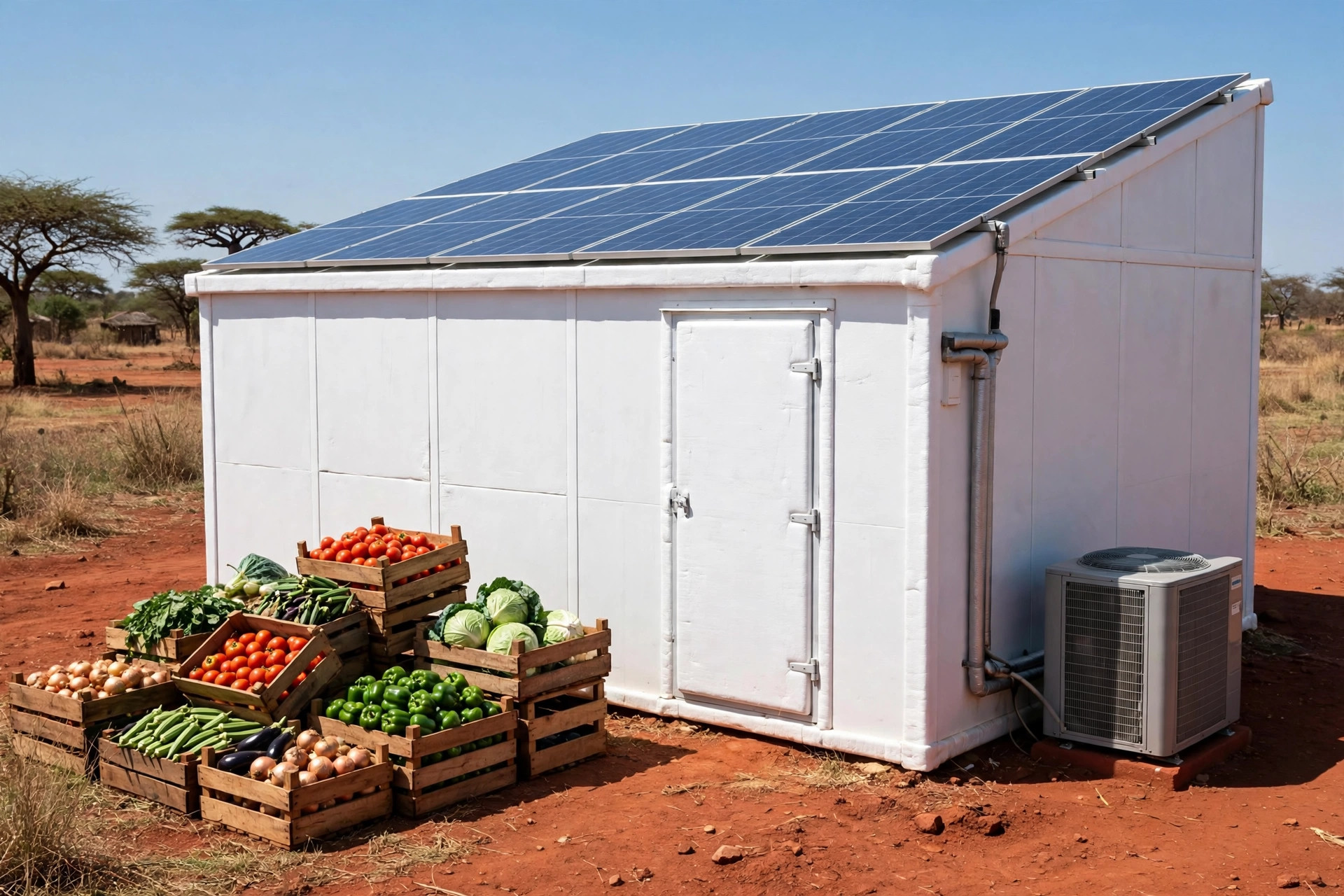
Across much of Africa the cold room itself is not the problem — power is. Outages and diesel costs spoil stock and eat margins. A solar cold room combines a well-insulated room, an efficient refrigeration unit, a PV array and battery storage, with the grid or a generator as backup, so the temperature holds day and night.
Thick PU panels (120–150 mm for freezers) do the first half of the job: the better the insulation, the smaller the solar system you must buy. Insulation is the cheapest "battery" there is.
High-efficiency condensing unit and evaporator, sized for the room and temperature band — run by inverter so it can follow solar supply smoothly.
Solar panels sized to the unit's daily energy use at your location's sun hours; battery storage carries the room through the night and cloudy spells, sized to the autonomy you need.
Automatic changeover to grid or generator when batteries run low, plus temperature alarms. The stock never depends on a single source.
| Setup | Best for | How it behaves |
|---|---|---|
| Hybrid (solar + grid/generator) | Towns and sites with some grid supply, high fuel costs | Solar carries the daytime load and part of the night; grid/generator tops up automatically. Smaller battery, lower upfront cost. |
| Fully off-grid (solar + battery only) | Remote farms, landing sites, off-grid markets | Oversized PV and battery for full autonomy; thickest panels recommended. Needs honest sizing for the worst month, not the best. |
Landing sites far from reliable grid: freezing and storing catch locally instead of selling cheap the same day or losing it. See also cold rooms for fish.
Vegetables, fruit and dairy held at source until transport arrives — cutting the post-harvest losses that happen in the first 24 hours.
Frozen food distribution points where diesel for daily generator running is the single biggest operating cost.
Yes — with correctly sized battery storage and thick panels, the compressor runs on battery at night and the room's insulation limits heat gain. The key is honest sizing: we calculate from your location's sun hours and your temperature band, not from best-case brochures.
Room size, target temperature, what you store and roughly how much per day, your location (for sun hours), and your current power situation: grid hours per day and whether you run a generator. The calculator gives the room side; add your power details in the message.
Usually yes if the room was built with adequate panel thickness and an inverter-compatible unit — one reason we recommend not thinning the panels to save money at order time. Tell us if solar is a future plan and we will specify the room ready for it.
Hybrid systems fall back to grid or generator automatically. Fully off-grid systems are sized with autonomy days in the battery bank, based on your worst-month sun conditions.
Tell us your location, room size, temperature and current power situation — we reply with hybrid and off-grid options and an exact quotation, normally within 24 hours on working days.
 ColdRoomKit